
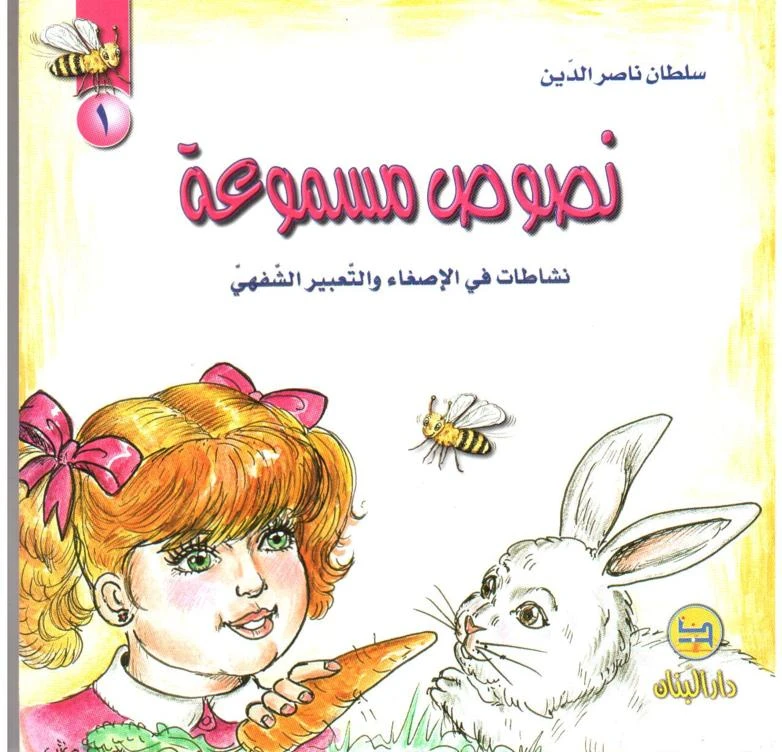
Description
Book included with C.D
Language is the basis of teaching and learning. The person who learns it is a developing person who is able to keep pace with the stages of growth continuously, because language is a result of growth and leads to its increase at the same time. This is what makes it a manifestation of the human personality, and an essential factor in its growth and construction.
Learning a language is one of the keys to knowledge; It opens up wide, comprehensive horizons for the child. It is food for the brain; Linguistic educational research has confirmed that human exposure to new words develops brain cells, keeps them in constant activity, and keeps them away from laziness and weakness.
When a person is born, he is like a blank page. The Creator has endowed him with hearing by which he perceives sounds, sight by which he perceives visible things, and the heart or mind with which he interprets, analyzes and chooses.
This means that language acquisition has multiple components of predisposition that together constitute a cohesive force.
These components are both organic and perceptual. The healthy senses and the nervous system are organic components; Perception (knowledge), understanding, application, analysis, composition, and reinforcement are perceptual components.
Based on this, scholars have seen that language skills are four: listening, speaking, reading and writing. Research has proven that the natural development of language acquisition in humans is achieved only by adhering to these skills sequentially, from listening to writing.
Let's suppose that a person knows the Arabic language well, and he wants to learn the German language, so he gets German books, stories and magazines. Can he acquire the German language without hearing it on someone's tongue, tape, or cylinder? Of course he can't. Why? Because he has not heard, he cannot speak, read, or write.
Listening is the primary linguistic activity in acquiring languages. It is necessary for the emergence of speech, reading and writing from a distance. Ibn Khaldun said: Hearing is the father of human faculties.
For the sake of our children, for the sake of a generation that masters and loves the Arabic language, it was “audible texts”.
We have tried audio activities, and it seems to us that their benefits are many; It develops in the learners the skill of listening, the faculty of concentration, and the language gives them ease, pleasure and joy, and it breaks the deadlock and lethargy, and keeps them away from turmoil.
Auditory activities are a natural way of acquiring language... Walking according to the method leads to building the learner's personality in a balanced manner and enhancing his linguistic abilities through communication, interaction and expression.
We preferred that some texts be educationally composed because the child loves rhythm, and because rhythm has an effect on nourishing the brain and controlling its work. This is proven by brain research.
The parameter can choose the appropriate axis, and conduct the activities in it.
This book is accompanied by a CD with the texts recorded in a clear and expressive voice, numbered and timed.
The instructions for the activities are clear at the beginning of each activity or on the disc. I wish that we train the learners to implement it correctly, so that we develop in them the value of commitment, so that the language becomes pliant on their tongues, their minds grow, and their personalities transcend.
This is our experience in the field of audio activities in the Arabic language, and we place it in the hands of the dear ones.
May it be good and beneficial for our younger generations. God grants success.
The first part contains eight axes, in audio texts, in each axis of activities that train the learner on:
Hearing and implementing instructions.
- casting
Retelling a text.
Answering questions related to the audio document.
- Read a picture.
Oral expression.
Each of the axes can be invested in more than one topic:
The first axis: health and food, animals, and agriculture.
The second axis: school, trees, hobbies.
The third axis: family, cooperation, love.
Fourth Axis: Winter, Prevention, and Assistance.
The fifth theme: Nature, giving.
Sixth Axis: Spring, the sea, the environment, childhood.
Seventh Axis: Animals, Freedom.
The eighth axis: animal welfare, time.
Product Code: 9789953517049
There are no reviews yet, be the first to share your opinion


